Epicentro da história do Império
Romano, Roma é hoje o cenário escolhido para inúmeros filmes, como o filme como
Para Roma com Amor (2012) de Woody Allen, Férias em Roma (1953), O Talentoso
Mr. Ripley (1999) ou a Grande Beleza (2015), etc. Não é de admirar, pois
séculos e séculos de história deram lugar a mais de 900 Igrejas e obras de arte
famosas espalhadas pelas ruas e museus da cidade, como é descrito, por exemplo,
no livro Anjos e Demónios de Dan Brown. Certamente que 3 dias não chegarão para
ver tudo o que Roma apresenta, mas dará para ficar com uma boa recordação
italiana. Assim, aqui fica a minha sugestão para 3 dias de passeio pela Cidade
Eterna. Nota que haverá muita caminhada, mas compensará as calorias dos
gelados, pizzas e pastas.
Central to the history of the Roman Empire, Rome is now the setting
chosen for many movies, such as Woody Allen's To Rome with Love (2012), Roman
Holiday (1953), The Talented Mr. Ripley (1999) or La Grande Belezza (2015),
etc. No wonder that, as centuries and centuries of history have originated into
more than 900 churches and famous works of art scattered throughout the streets
and museums of the city, as described for example in Dan Brown's Angels and
Demons. Certainly 3 days aren’t enough to see all that Rome offers, but it will
leave you with a good Italian souvenir So, here is my suggestion for a 3-day
tour of the Eternal City. Note that there will be a lot of walking, but will
compensate for the calories from ice cream, pizzas and pastas.
 |
| Buongiorno Roma (photo by Littlelle) |
 |
| Vespas everywhere (photo by Littlelle) |
 |
| Be Italian (photo by Littlelle) |
 |
| Wandering around the little streets of Rome (photo by Littlelle) |
 |
| Sweet places (photo by Littlelle) |
 |
| Nice restaurants (photo by Littlelle) |
 |
| Don't you ever miss the italian gelato (photo by Littlelle) |
 |
| Everyday is a gelato day (photo by Littlelle) |
Day 1
Católico ou não, o
Vaticano é um
ponto de passagem quase obrigatório para quem visita Roma. Para além da
monumental Praça de S. Pedro, com a colunata de Bernini, podes visitar o Museu
do Vaticano e passar um dia inteiro lá dentro, ou parte dele nas extensas filas
(entrada 16€). O museu, para além da esperada arte sacra, renascentista e da
fantástica Capela Sistina, apresenta também uma coleção de arte contemporânea,
com obras de Salvador Dali, Francis Bacon ou Matisse. Para visitares a
Catedral, a fila já é outra, um pouco menos morosa e sem bilhete. Lá dentro,
encontras a famosa Pietá de Miguel Ângelo. Quem fizer questão de ir a Roma e
ver o Papa, as audiências papais realizam-se às 4ªs feiras de manhã. Para
chegares ao Vaticano podes apanhar o Bus ou Metro com saída em Ottaviana (Metro
1,5€).
Catholic or not, the Vatican is almost a mandatory site for anyone
visiting Rome. In addition to the monumental St. Peter's Square, with Bernini's
colonnade, you can visit the Vatican Museum and spend a whole day inside it, or
part of it in the long queues (admission 16 €). The museum, in addition to the
expected religious, Renaissance art and Sistine Chapel, also features a
collection of contemporary art, with works by Salvador Dali, Francis Bacon or
Matisse. To visit the Cathedral, the queue is another one, a bit less time consuming
and without a ticket. Inside, you will find Michelangelo's famous Pieta. Anyone
who wants to go to Rome and see the Pope, papal audiences are held on
Wednesdays in the morning. To get to the Vatican you can take the Bus or Metro
with exit in Ottaviana (Metro 1,5 €).
 |
| St Peter Square (photo by Littlelle) |
 |
| Vaticano Museum (photo by Littlelle) |
 |
| Salvador Dali painting at Vaticano Museum (photo by Littlelle) |
 |
| Francis Bacon painting at Vaticano Museum (photo by Littlelle) |
 |
| St. Peter's Basilica (photo by Littlelle) |
 |
| Pietà of Michelangelo at St. Peter's Basilica (photo by Littlelle) |
Após as visitas, ao saíres do
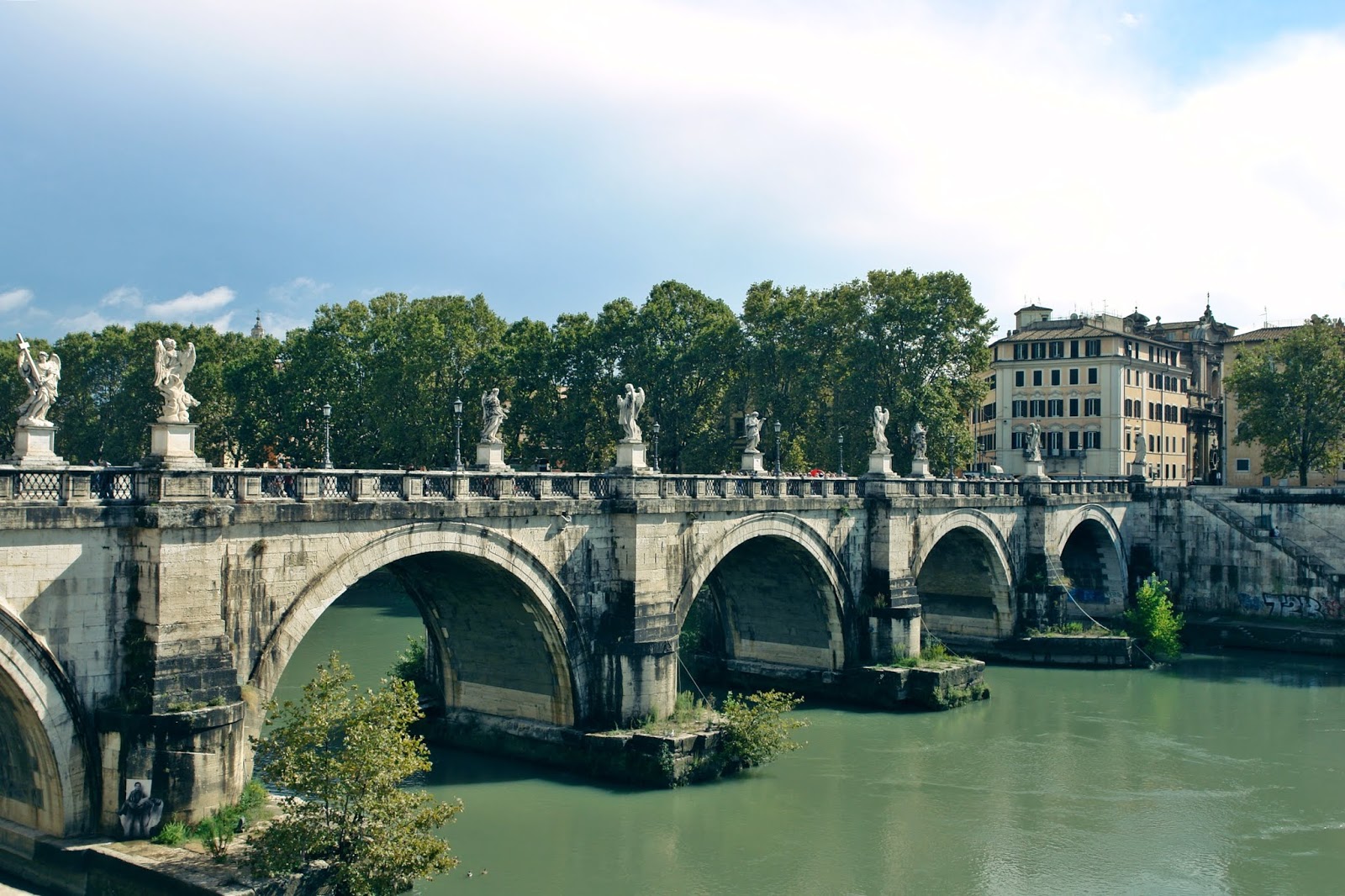
Vaticano podes passar a Ponte Sant'Ângelo, com estátuas de Bernini que te levam
até ao Castelo com o mesmo nome, encontrando-se na margem direita do Rio Tibre.
Em tempos este castelo servia
para fortaleza e prisão.
After the visits, when leaving the Vatican you can pass Sant'Angelo
Bridge, with Bernini statues that lead you to the Castle with the same name,
which is on the right bank of the Tiber River. Once this castle was served for
strength and prison.
 |
| Sant'Angelo (photo by Littlelle) |
 |
| Sant'Angelo, the bridge of angels (photo by Mário Santos, edited by Littlelle) |
Depois de tanta arte, sugiro
caminhares um pouco até Trastevere, percorrendo o caminho sempre lado a lado
com o Tibre, para comeres um delicioso gelado (sugestão: Blue, 2,5€ por 2 bolas
de gelado) enquanto te perdes nas ruas e ruelas deste bairro pitoresco.
Trastevere é um ótimo sítio para jantar, apresenta muitos restaurantes típicos,
com preços mais convidativos do que o centro da cidade.
After so much art, I suggest walking a little to Trastevere, walking
along the path always side by side with the Tiber, in order to eat a delicious
ice cream (suggestion: Blue, € 2.5 for 2 balls of ice cream) as you get lost in
the streets and alleys of this picturesque neighborhood. Trastevere is a great
place to have diner, it has many typical restaurants, with prices more inviting
than those in the city center.
Day 2
Entre tanta igreja, torna-se
normal encontrares uma em cada esquina da cidade. Se quiseres, podes passar o
dia todo a percorrer as capelinhas de Roma. Eu, como sou um pouco “seletiva” no
que que toca a igrejas, recomendo a Basílica de Santa Maria Maggiore, uma das
quatro maiores basílicas de Roma. Destaco também a Basílica de St. Pietro in
Vincoli, que apesar de se encontrar localizada num sítio discreto, possui no
seu interior o famoso Moisés de Miguel Ângelo. Podes passar por esta igreja já
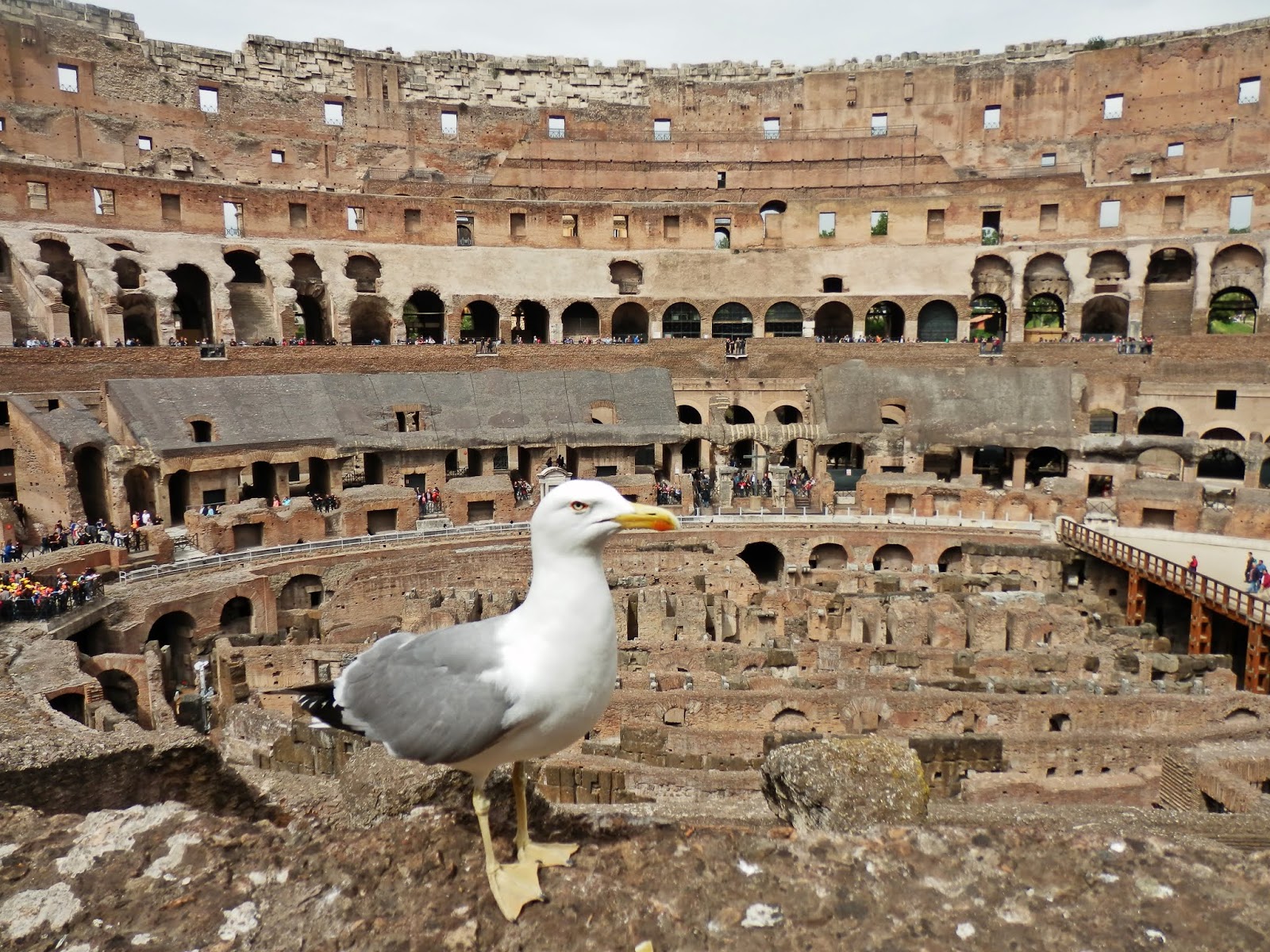
a caminho do ícone da cidade, o Coliseu. Este é monumental, tal como o imaginamos.
A visita por dentro será mais interessante e valerá a pena se quiseres ouvir um
áudio guia. A entrada no Coliseu e no adjacente Fórum Romano custa 12€.
Among so many churches, it's normal
to find one on each corner of the city. If you want, you can spend the whole
day going through the little chapels of Rome. I, as I am a little
"selective" regarding churches, (I) recommend the Basilica of Santa
Maria Maggiore, one of the four largest basilicas in Rome. I also note the
Basilica of St. Pietro in Vincoli, which although located in a discreet site,
has inside the famous Moses of Michelangelo. You can walk past this church on
your way to the icon of the city, the Colosseum. This one is monumental, as we
imagine it. The inside visit will be more interesting and worthwhile, if you
want to listen to an audio guide. The entry to the Colosseum and the adjacent
Roman Forum costs € 12.
 |
| Roma Capitale (photo by Littlelle) |
 |
| Church after church (photo by Littlelle) |
 |
| Basilica of Santa Maria Maggiore (photo by Littlelle) |
 |
| Basilica of Santa Maria Maggiore (photo by Littlelle) |
 |
| What does it hide? (photo by Littlelle) |
 |
| Moses of Michelangelo at the Basilica of St. Pietro in Vincoli (photo by Littlelle) |
 |
| What's the name again? :) (photo by Littlelle) |
 |
| Inside the Colosseum (photo by Littlelle) |
 |
| Arch of Constantine (photo by Littlelle) |
 |
| The ancient Roman Forum (photo by Littlelle) |
 |
| The ancient Roman Forum (photo by Littlelle) |
Após a viagem no tempo até às
glórias e desgraças do Império Romano, podes caminhar até ao imponente
monumento dedicado a Vittorio Emanuele II, primeiro rei de Itália, localizado
na
Piazza di Venezia. Ao lado do mesmo, existe uma escadaria que te leva
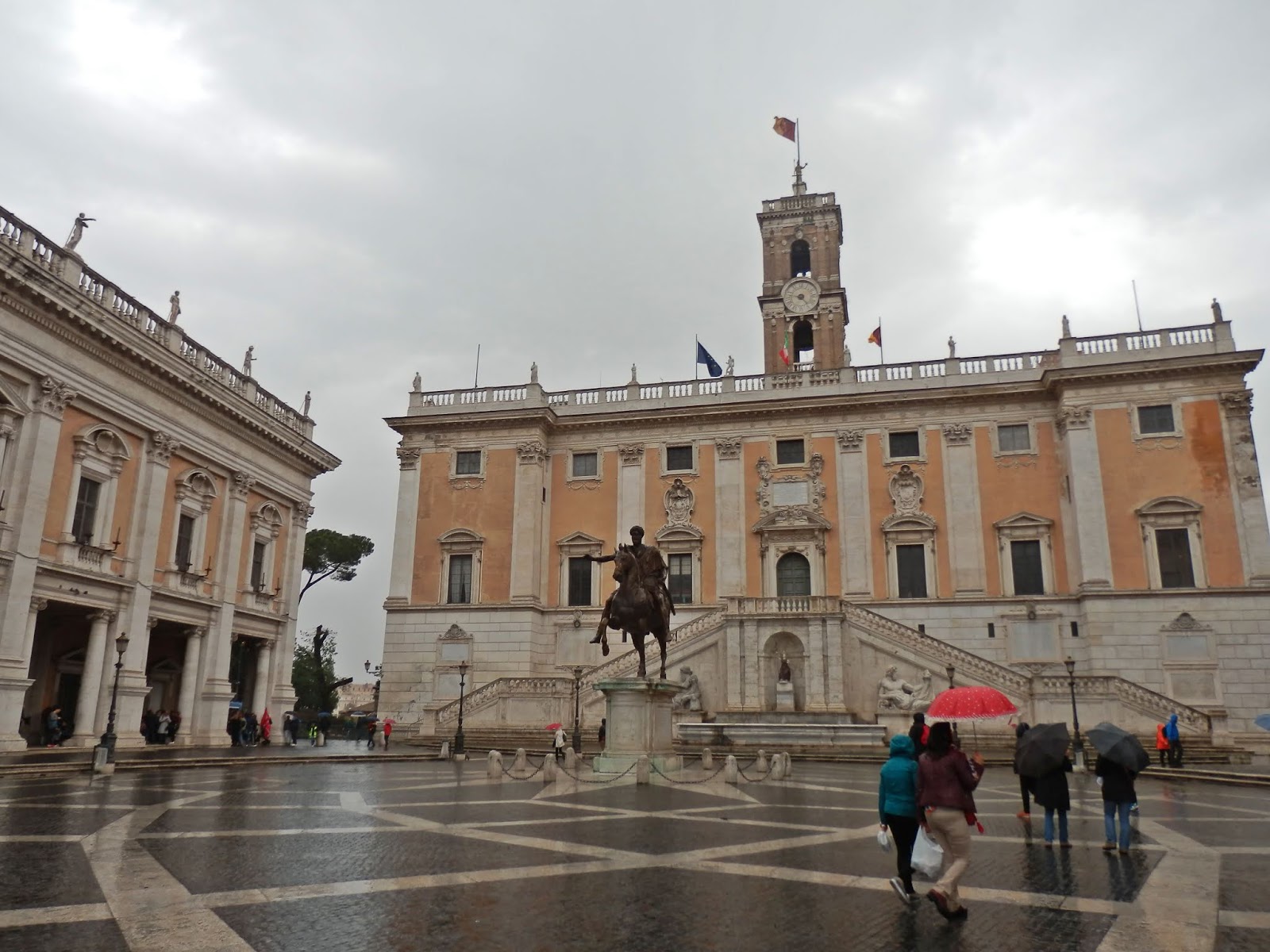
até até à Piazza del Campidoglio, construída por Miguel Ângelo, onde tens uma
vista bonita sobre o Fórum Romano. Aí tens também os Museus Capitolinos
, onde está o ícone da fundação
de Roma, a loba a alimentar Rômulo e Remo. Nesse museu tens uma estátua que
surge no filme de Paolo Sorrentino – A Grande Beleza.
After traveling back in time to the
glories and misfortunes of the Roman Empire, you can walk to the imposing
monument dedicated to Vittorio Emanuele II, the first king of Italy, located in
Piazza di Venezia. Next to it, there is a staircase that takes you up to the
Piazza del Campidoglio, built by Michelangelo, where you have a beautiful view
to the Roman Forum. There you also have the Capitoline Museums, where is the
icon of the foundation of Rome, the wolf feeding Romulus and Remus. In this
museum you have a statue that appears in the movie of Paolo Sorrentino - La
Grande Belezza.
 |
| Monument dedicated to Vittorio Emanuele II (photo by Littlelle) |
 |
| Piazza del Campidoglio (photo by Littlelle) |
 |
| The ancient Roman Forum (photo by Littlelle) |
 |
| Wolf feeding Romulus and Remus (photo by Littlelle) |
 |
| Recognize it form La Grande Belezza? (photo by Littlelle) |
Day 3
Em Itália, para além da arte e da
história, não nos podemos também esquecer da moda. Relativamente a esta área,
em Roma, a Piazza di Spagna e a sua famosa escadaria são o grande
epicentro! As grandes casas de alta-costura têm todas a sua morada ali. Uma das ruas adjacentes, a
charmosa Via Margutta é um miminho para amantes de arte, e existem várias
galerias onde o ambiente é muito agradável. Se percorreres esta rua chegarás a
Piazza del Popolo, onde tens mais uma grande igreja, a Igreja Santa Maria del
Popolo.
In Italy, beyond art and history, we cannot forget fashion. In this
area, in Rome, Piazza di Spagna and its famous staircase are the great center!
The great haute couture houses have their address there. One of the adjacent streets, the charming Via Margutta is a must go for
art lovers, there are several galleries where the atmosphere is very pleasant.
If you follow this street you will arrive at Piazza del Popolo, where you have
another big church, the Church Santa Maria del Popolo.
 |
| Piazza di Spagna (photo by Littlelle) |
 |
| Via Margutta (photo by Littlelle) |
No outro sentido da
Piazza di
Spagna, passando pela Igreja de Santo António dos Portugueses, podes ir até
à famosa Piazza Navona, onde encontras a conhecida Fontana dei Quattro Fiumi de
Bernini.
Later on, you can stop for lunch in one of the Campo dei Fiori
restaurants, where you will find a picturesque traditional market with several
ingredients to make a delicious pasta. Around this market you have many alleys
that make up the ghetto.
 |
| Campo dei Fiori (photo by Littlelle) |
 |
| Campo dei Fiori (photo by Littlelle) |
 |
| Chips pizza (photo by Littlelle) |
Não muito longe, na
Piazza
della Rotunda, encontras um enorme edifício redondo, o Panteão (entrada
gratuita), onde se encontram sepultados algumas das ilustres personagens
italianas, entre elas, o artista Rafael.
Not far away, in Piazza della Rotunda, you will find a huge round
building, the Pantheon (free admission), where some of the illustrious Italian
characters are buried, among them the artist Raphael.
 |
| The eye of the Pantheon (photo by Littlelle) |
Novamente entre ruas e ruelas,
sempre que possível de gelado numa mão e máquina fotográfica noutra, vais
desembocar na
Fontana di Trevi e se conseguires passar o mar de gente
que ali normalmente se encontra, atira uma moedinha de costas para a fonte e
pede um desejo.
O meu seria
“quero aqui voltar” :)
Again between streets and alleys, wherever possible ice cream in one hand and camera in another, you will end up in the Fontana di Trevi and if you manage to pass the huge amount of people who are normally there, throw a coin back to the source and asks for a wish. Mine would be "want to come back" :)
 |
| Fontana di Trevi (photo by Littlelle) |
Sim, pois numa próxima paragem por esta cidade gostaria de conhecer a Villa Borghese e o Museu Chiostro Bramante.
Yes, because on a next stop in this city I would like to visit Villa
Borghese and the Chiostro Bramante Museum.
 |
| Rome souvenirs (photo by Littlelle) |
 |
| Arrivederci Roma (photo by Littlelle) |